

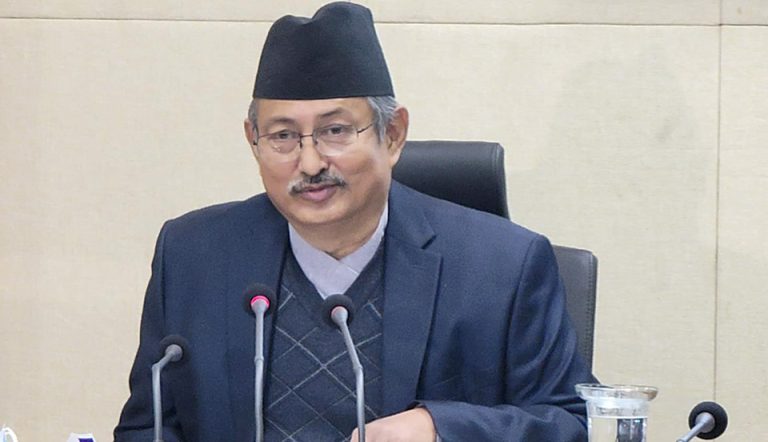

Minister for Home Affairs Bal Krishna Khand Sunday said that the government is committed to save the bright future of the young generation and protect the citizens from drug addiction.
Speaking at a programme organised by the Ministry of Home Affairs in Kathmandu on the occasion of the International Day against Drug Abuse and Illicit Trafficking, Khand said it was the responsibility of all to save the youth from drug addiction.
He said that drug addiction has seriously affected the society and the young generation is being affected the most. Home Minister Khand said that it was the responsibility of the government and the society to save the younger generation from drug addiction.
In order to make the future of the younger generation brighter, the government needs to bring public awareness programmes in the coming days, inform the students about the effects of drug addiction in the textbooks and launch a special campaign to improve the youths who are addicted to drugs, Minister Khand said.
He also said that the government was working sensitively to reduce drug addiction.
“Illicit use of drugs is emerging as a challenge in Nepal. Drug addiction has seriously affected the society. The younger generation is being affected the most. It is the responsibility of all of us to save our young generation from addiction,” said the Home Minister.
In the days to come, the government should pay more attention, bring awareness programmes, include the subject in textbooks, inform the students in time, and start a campaign to improve the youth who are addicted, Minister Khand suggested.
He said more than 6,000 inmates convicted of drug-related offenses were currently in jail and that more than eight per cent of all criminal activities across the country were related to drugs. On the occasion, Home Secretary Tek Narayan Pandey and Inspector General of Nepal Police Dhiraj Pratap Singh said that all citizens need to be vigilant to build a drug-free family, society and nation.
Minister Khand also honoured various anti-drug organizations working in this sector. Prior to this, a morning procession was organised from the National City Hall to Bhadrakali, Sundhara, New Road, Ratna Park, Baghbazaar and back to the City Hall.
Since 1987, the Anti-Drug Day has been observed globally with the goal of creating a world free of drug abuse.
In Nepal, the Ministry of Home Affairs through the Narcotics Control Bureau (NCB) of Nepal Police has been carrying out different activities nationwide following an integrated approach to combat drug problems. But still, the number of drug users is escalating in Nepal, said Dr. Bhishma Kumar Bhusal, Chief Drug Control Officer at the Ministry.
A survey on drug users and its situation in Nepal conducted by the Ministry of Home Affairs in 2020 stated that the drug users in Nepal were increasing by five per cent in a year.
“A report of Nepal Drug Users Survey-2020 showed that the annual drug users’ growth rate is five per cent from 2013 to 2020,” Dr. Bhusal said. The Ministry, based on this report, had also released ‘National Master Plan on Prevention and Control of Narcotic Drugs 2079-2084 B.S’ this April.
130,424 drug users in Nepal According to the survey, there are currently 130,424 drug users in Nepal, and of them, 8,372 are women (6.7 per cent) and 121,692 (93.3 per cent) are men. The data were collected for the survey purpose by the Narcotic Drugs Section under Ministry from 2013 to 2020.
According to the survey, 5,000 drug abusers are currently undergoing treatment in different rehabilitation centres in Nepal, and 1,000 are receiving counselling from the rehabilitation centres.
The survey has shown that most drug users take at least one specific form of drug for the first time in their life before the average age of 19 years.
The master plan has stated out of the total criminal incidents, 9 per cent involve drug related crimes. Similarly, 4,626 drug users have been arrested in the fiscal year 077/78 and cases have been filed against 3,013 of them, out of which 147 are foreign nationals.
Similarly, Kathmandu, Rupandehi, Kaski, Kailali and Parsa are identified as major drug trading hub districts.
According to the survey, the rate of using cannabis is highest among the initial or beginner drug users. This is 80.4 per cent.
Bhusal said that of the total 26,000 inmates across the country as of mid-November 2021, 21 per cent inmates were implicated in drug trading and abuse cases.
The report has also mentioned that there were 275 million drug users across the world as of 2019, according to the report of the United Nations Office on Drugs and Crime (UNODC). This figure was 22 per cent more than that of 2010 report. Of the total users, 10.1 million people in the world use syringe-based drugs directly into their vein.
Dr. Bhusal said the Master Plan has also aimed at replacing the old Narcotic Drugs (Control) Act 1976 with new one as Narcotic Drugs (Control) and Psychotropic Substance Act which is currently being formulated.
The master plan has also aimed at introducing a test kit system to immediately confirm drug users, set up drug detection device in the customs office and increase security surveillance and patrolling in the border points.
Source : TRN,