

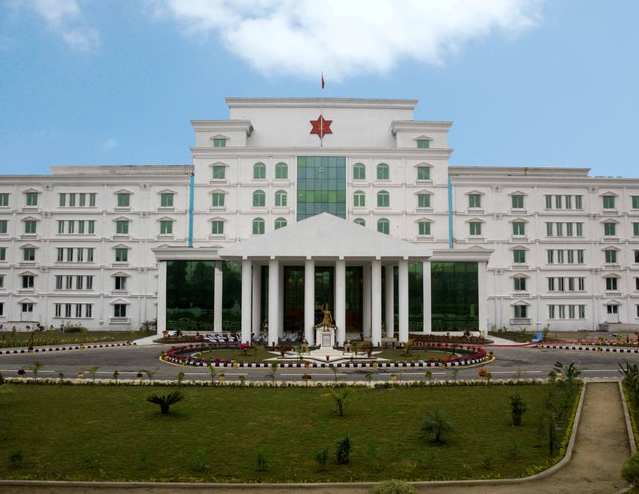

A year after exercising the new Command Structure into practice, the Nepali Army Headquarters (NAHQ) has finally returned to its old structure—Division Headquarters – citing that the new structure was impractical and financially expensive.
“Owning to financial and practical technicalities, for now, the new Command Structure introduced in the Nepali Army a year ago has been put into hold, reviving the previously exercised Division Headquarters concept across the country,” Brigadier General and Spokesperson for the Nepali Army Headquarters Narayan Silwal said on Thursday.
He said that the decision was taken by a Cabinet meeting held on September 6 upon the recommendation of the National Security Council. The Council is headed by Prime Minister and Defence Minister Sher Bahadur Deuba.
The Command Structure as such will remain the same and may come into operation in future if the state so feels, but for now, the previously implemented Division Headquarters concept will be in place immediately, said Silwal, who is also the Director at the Directorate of Public Relations and Information under the Army Headquarters.
“During our one-year field-based experience, the Command Headquarters concept has been found unsuitable both financially and practically,” Silwal said.
The Command Structure concept had been named as three-plus one structure. namely the Eastern Command, Western Command, Central Command and the Valley Command.
Theses Command structures were developed on the basis of the three main rivers– Koshi, Gandaki and Karnali, while the Valley Command was kept analsying the security sensitivity of the Capital City.
It has been estimated that millions of rupees have to be spent every year in setting up new infrastructure to function under the Brigade, Battalion and Companies across the country while operating the NA under the Command Structure, he said.
All Brigade offices come under the control of Command Headquarters. Earlier, there were eight Division Headquarters – seven in each province and one in the Capital as Valley Division Headquarters.
The Council of Ministers held on September 6 decided to revive the old Division Headquarters concept keeping the present Command Headquarters concept intact, according to Brigadier General Silwal.
He also said that it was difficult to Indiafunction under the new structure, and the army said that the Division Headquarters concept would be revived and brought into practice before November 20 elections.
Now, according to the old structure, the army will have Eastern, Mid-Eastern, Central, Valley, Western, Mid-Western, North-Western and Sudurpaschim Division Headquarters.
After the country adopted the federal structure, the army had even increased the number of the Division Headquarters in view of the seven provinces. Eight Division Headquarters were established in the army, seven in seven provinces and one in Valley. But on July 8, 2021, the Council of Ministers cancelled the Division Headquarters and implemented the command concept.
However, the commandant or chief to lead each Command Headquarters and Division Headquarters will remain the same – major general, the two-star general.
The new concept of command structure was implemented by the ex-army chief Purna Chandra Thapa.
Before the promulgation of the constitution in Nepal in 2015, there were five development regions and six Divisions Headquarters in the army. After the promulgation of the constitution, two Divisions were added with one Division each in seven provinces and the Kathmandu Valley.
Source : TRN,
