

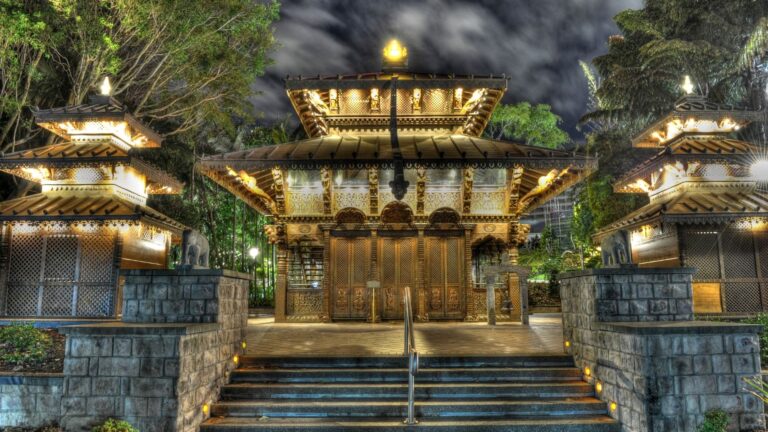

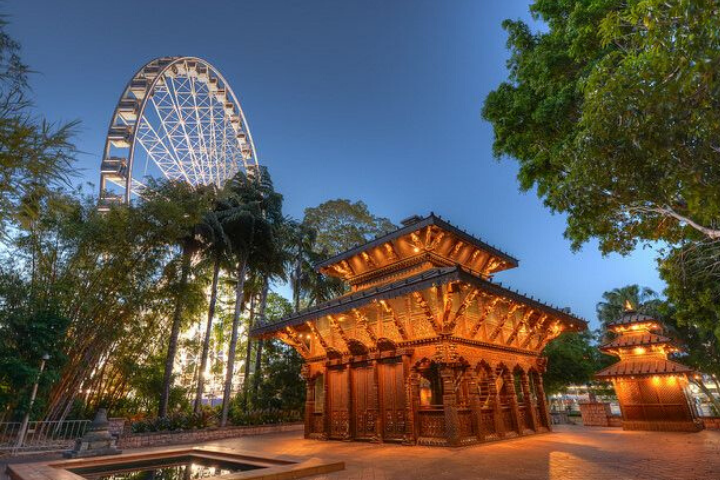
Far from the towering peaks of the Himalayas, a sacred piece of Nepal stands proudly in the heart of Brisbane. The Nepalese Peace Pagoda in South Bank Parklands is more than just an architectural marvel — it is a living symbol of Nepalese artistry, spirituality, and the enduring friendship between Nepal and Australia.
One of only three Nepalese pagodas outside Nepal (the others being in Munich and Osaka), the Brisbane structure remains a cherished legacy of World Expo 88 and a proud representation of Nepal’s rich heritage.
A Pagoda Built by Nepal, for the World
The story of the pagoda begins with Nepal’s decision to participate in World Expo 88. Architect Jochen Reier, a German who had lived in Nepal for years and grown deeply inspired by its architecture, spearheaded the project. His vision, however, would not have been possible without the blessing of King Birendra and the immense support of the Nepalese people.
Constructed entirely in Nepal by over 160 Nepalese artisans and families, the pagoda took more than one million hours of labour. Traditionally, such a structure would take double that time to complete, but the dedication of the Nepali craftsmen — carving, shaping, and assembling every detail by hand — made the impossible happen.
The materials used were sourced from Nepal’s Terai forest, with over 80 tonnes of timber forming the body of the pagoda. It was later transported via Calcutta to Australia, before being reassembled at South Bank.
“This is Nepal’s soul carved in wood,” Mr. Reier once said. Even King Birendra was moved, telling Reier that he loved the pagoda as if it were his own child.
A Cultural Bridge Across Continents
While many pavilions from World Expo 88 were dismantled or relocated, the Nepalese Peace Pagoda survived thanks to overwhelming public support. A local group called Friends of the Pagoda led a petition to keep the structure in Brisbane, where it was reassembled in 1992.
For Brisbane’s Nepali community, the pagoda is much more than a monument — it is a sanctuary of identity, culture, and emotional connection.
“It’s a blessing,” says Sambhu Gaishe, Vice President of the Nepalese Association of Queensland. “When our parents visit, it’s the first place we take them. Their faces just light up — they see home in that structure.”
Though it is not a functioning temple, the pagoda is architecturally and spiritually authentic. In Nepal, such a space would house deities and host daily offerings. In Brisbane, it serves as a cultural touchstone, a place of quiet reflection, and a reminder of heritage.
“When you step inside, it feels like you’ve left Australia and entered Nepal,” Gaishe said. “It is a way to pass on stories to our children. They see the intricate carvings and hear about the meaning behind them. It becomes a classroom of culture.”
A Growing Community and Enduring Pride
Nepal’s presence in Australia continues to grow. According to the Australian Bureau of Statistics, the Nepali population has surged from just over 34,000 in 2013 to more than 179,000 by 2023. Nepal is now the third largest source of international students in Australia, after China and India.
This growing influence was recognized at Brisbane’s Nepalese Festival, where Prime Minister Anthony Albanese and Queensland Premier David Crisafulli both paid tribute to the contributions of the Nepali community.
“You are helping build a stronger, more vibrant nation,” the Prime Minister said. “Your culture, work ethic, and community spirit are an inspiration.”
More Than Wood and Stone — It’s a Legacy
The Nepalese Peace Pagoda stands today not only as an icon of Expo 88 but as a living legacy of Nepal’s cultural diplomacy, craftsmanship, and diaspora pride.
For the thousands of Nepalese living in Queensland — and for the many more Australians who visit each year — the pagoda is a symbol of what Nepal gave to the world: peace, beauty, and a shared humanity carved in wood.
As Sambhu Gaishe puts it: “It’s not just ours anymore. It belongs to Brisbane, to Australia — and to every heart that finds peace in its presence.”
